What is a flow wrap machine,
and how does it work
Introduction
If you’ve ever bought a chocolate bar, biscuit, or soap, you’ve already seen flow wrap packaging in action. But have you ever wondered how a flow wrap machine works and why so many industries—from food to pharmaceuticals—depend on it?
In today’s manufacturing world, packaging is more than just wrapping a product. It’s about hygiene, precision, and speed. Manual packaging can be inconsistent, time-consuming, and prone to contamination. That’s where a flow wrap machine steps in — an automated system designed to deliver fast, reliable, and hygienic packaging for a wide range of products.
At Arceus India, we specialize in manufacturing flow wrap packing machines that combine automation, accuracy, and efficiency — helping businesses minimize waste and maximize production.
What is a Flow Wrap Machine?
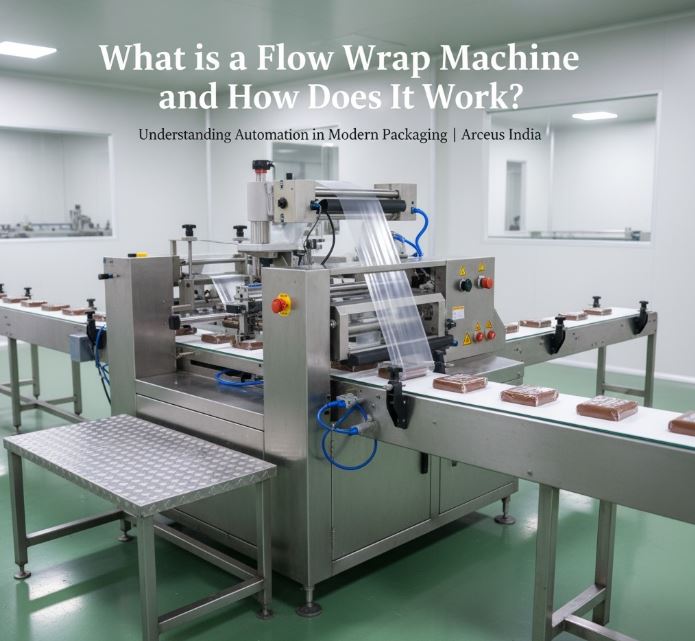
A Flow Wrap Machine, also known as a horizontal flow wrapper, is a fully automatic system that wraps individual products in heat-sealable film. It forms, fills, seals, and cuts the packaging film continuously — making it one of the fastest and most efficient packaging solutions in the market.
In simple terms, a flow wrap machine creates a continuous “tube” of film around a product, seals it from all sides, and cuts it into individual packs. This results in perfectly sealed, tamper-proof, and attractive packaging.
Explore Flow Wrap Packing Machines by Arceus India
These machines are widely used in industries such as food, bakery, dairy, pharmaceuticals, cosmetics, and hardware, where consistent quality and hygiene are essential.
How Does a Flow Wrap Machine Work? (Step-by-Step Process)
- Product Feeding: Products such as biscuits, protein bars, or soaps are placed on an infeed conveyor belt. The belt carries the items in a line toward the wrapping section.
- Film Wrapping: A large roll of heat-sealable film (like BOPP or PET laminate) unwinds and wraps around each product. The film forms a continuous tube around the items.
- Sealing: Using heat and pressure, the machine creates one longitudinal seal (back seal) and two end seals. This keeps the product tightly enclosed and hygienically sealed.
- Cutting: A precision cutting knife separates each pack, producing individually sealed products that are ready for boxing or direct sale.
This process ensures high-speed, dust-free, and consistent packaging across all products — whether it’s chocolates, snacks, or medical supplies.
Function of a Flow Wrap Machine
The primary function of a wrapping machine is to protect the product from contamination, moisture, and physical damage while maintaining freshness and presentation. Unlike plastic wrap, which involves manual or semi-manual wrapping, a flow wrap machine automates the entire process — ensuring speed, uniformity, and hygiene.
This makes it ideal for industries where precision and visual appeal matter, such as confectionery, bakery, cosmetics, and healthcare.
Components & Working Principle of Flow Wrap Machines
- Infeed Conveyor: Aligns and feeds products at uniform spacing.
- Film Reel & Forming Box: Feeds and shapes the film around the product.
- Sealing Jaws: Use heat to create airtight seals on both ends.
- Cutting Knife: Cuts each pack to uniform size.
- PLC Control Panel: Controls film speed, sealing time, and temperature for consistent operation.
Difference Between Flow Wrap and Over Wrap Packaging
| Feature | Flow Wrap | Over Wrap |
|---|---|---|
| Process | Continuous film wrapping | Folded wrapping around a tray or box |
| Speed | High-speed, automatic | Moderate, semi-automatic |
| Product Type | Individual items | Grouped or boxed products |
| Applications | Chocolates, biscuits, soaps | Gift boxes, DVDs, cartons |
Flow Wrap Packaging Materials
- BOPP (Biaxially Oriented Polypropylene) – for snacks and confectionery.
- PET/PE Laminates – for dairy and frozen items.
- Aluminum Foil Laminates – for moisture-sensitive or pharma products.
- Heat-Sealable Laminated Films – for airtight and durable seals.
All Arceus India Flow Wrap Machines support these materials — ensuring compatibility with your existing production line.
Applications & Industries That Use Flow Wrap Machines
- Food & Beverage: Chocolates, biscuits, protein bars, bread, cookies
- Bakery & Confectionery: Muffins, pastries, rusks, rolls
- Pharma & Medical: Tablets, syringes, gloves, bandages
- Cosmetics & Personal Care: Soaps, razors, wet wipes, creams
- Stationery & Hardware: Batteries, bolts, toys, screws
Cost, Lifespan & Operation
- Cost: The flow wrap machine price varies depending on model, size, and automation level. In India, it typically ranges from ₹3.5 lakh to ₹12 lakh.
- Lifespan: With regular maintenance and cleaning, a stainless-steel flow wrap machine can easily last 8–12 years while maintaining consistent performance.
Benefits of Flow Wrap Machines
- High-Speed Packaging: Up to 200 packs per minute
- Accurate Sealing: Consistent, leak-proof sealing
- Energy Efficiency: Low power consumption and operating cost
- Reduced Labor Dependency: Automation minimizes manual effort
- Compact Design: Saves factory floor space
- Low Maintenance: Built for durability and reliability
Explore models like the 350 Conveyor, 450 Chain Pusher & Collar Type at Arceus India.
Conclusion
In today’s competitive manufacturing world, Flow Wrap Machines are essential for achieving fast, consistent, and hygienic packaging. Whether you’re packaging biscuits, protein bars, dairy items, or medical supplies, Arceus India’s advanced Flow Wrap Packing Machines deliver speed, reliability, and performance that help you scale your production efficiently.
Looking for a trusted Flow Wrap Machine Manufacturer in India? Talk to our experts for a free consultation or demo today.